The Long and Eventful Journey of the SOIL Household Toilet Design
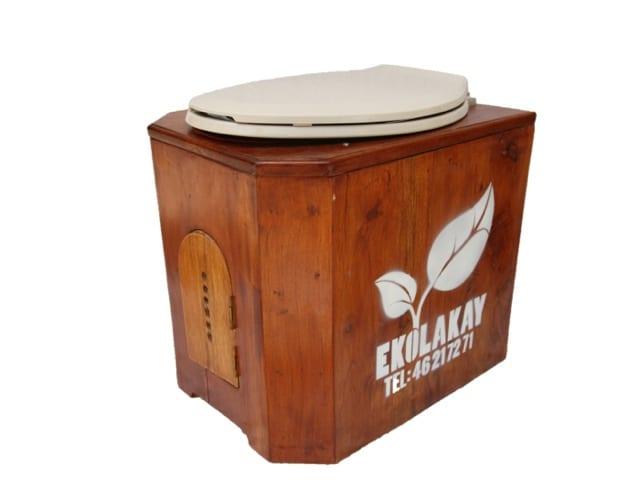
The development of SOIL’s household urine diversion toilet, aka the EkoLakay toilet, has been an iterative process. We thought that it would be great to share that history with you: EcoSan lovers, SOIL fans, and toilet developers around the world! A good toilet design should take into account cultural practices and habits and should be ergonomic, durable, practical and last, but not least, aesthetically pleasing.
Let’s walk though our household toilet development from the beginning:
- 2009: The Clay Pot
- 2011: The Artsy Wooden Box
- 2012: The Shiny Formica re.source Toilet
- 2013: The (Too-)Heavy-Duty Concrete Toilet
- 2014: The Fancy Wooden EkoLakay Toilet
- 2014: The Beautiful Ferro-Cement Ekolakay Toilet
Bonus sections:
2009: The Clay Pot
SOIL’s household toilet made its debut in 2009 as part of a project in collaboration with Oxfam Great Britain. The goal of this project was to design a small and portable ecological toilet that could fit in very small urban households and which would allow for easy removal of urine and feces. The first toilets were designed using a urine diversion mold imported from Mexico and were made using local clay. Our very first toilet of this model is still in use to this day at the SOIL farm and if you have a chance to visit you can experience this piece of SOIL history first hand! 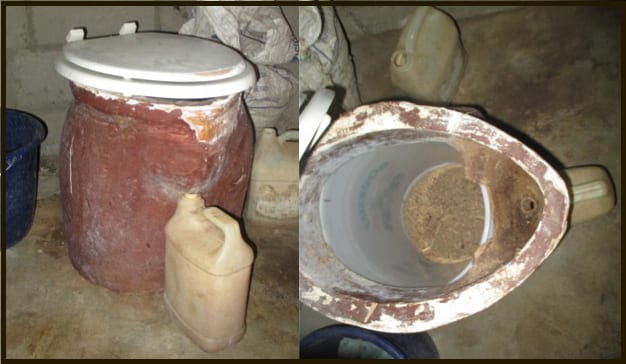
Advantages:
- Durable
- Inexpensive ($30 USD)
- Small
- Urine level easy to see to prevent overflows
Drawbacks:
- Heavy
- Breakable
- Urine gallon visible which some clients do not like
- Mold difficult to get into Haiti as it is imported
2011: The Artsy Wooden Box
When the earthquake happened in 2010 the household toilet project was temporarily put on hold as the team focused on emergency response. In 2011 the project recommenced with the second household toilet model made from plywood. It included a container on the side for storing cover material and a side door for cleaning and access to the pee gallon and poop bucket. The toilet seat was made out of sturdy fiberglass and included a urinal. This toilet was installed in a few households in Shada II, Cap-Haitien in 2012. 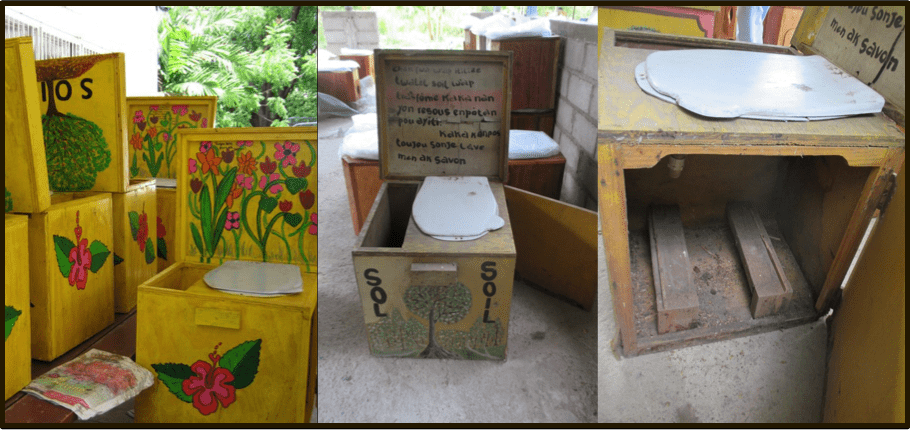
Advantages:
- Beautiful and sturdy
- The seat has an integrated sturdy urinal
- Includes a container for the cover material
Drawbacks:
- Expensive urinal/seat (the seat alone was $75 USD and the entire toilet around $125 USD)
- A bit large
2012: The Smooth Form re.source Toilet
The next household toilet model was developed in 2012 in collaboration with re.source (a team of Stanford researchers led by of Kory Russel and Sebastien Tilmans). This toilet went through many many iterations as part of an intensive user-centric design process. It was constructed locally, using materials bought in local markets and hardware stores. The toilet had an internal frame constructed from wood that was covered by a masonite and formica laminate. The urinal was made in the USA by the Stanford team out of plastic, but the Stanford team subsequently worked with SOIL to set up a local plastic molding process (see below). In the urinal, a simple gauge system was made out of a ping-pong ball and a straw to give an indication of the level of pee in the gallon. When the pee gallon is full, the ping-pong ball would ascend and be visible to the user. The toilet had a side door for cleaning and access to the poop bucket and pee gallon. This toilet model was installed in 150 households in Shada II as part of a pilot study with re.source. 
Advantages:
- Small
- Attractive
- Inexpensive (Around $70 USD including urinal)
- Easy to clean
Drawbacks:
- Short lifespan especially in areas prone to flooding (masonite and plywood swell and lose strength if they get soaked, and the materials can delaminate after getting wet)
- The urinal plastic is weak and breaks easily
2013: The (Too) Heavy-Duty Concrete Toilet
To improve the lifespan of our toilets and reduce the maintenance cost, we developed various concrete toilet models reinforced with steel. They were made with a mold made from wood, and some had a side opening. It had a removable wooden top made from Haitian wood with a screwed plastic molded urinal and a seat. The toilet had no bottom. 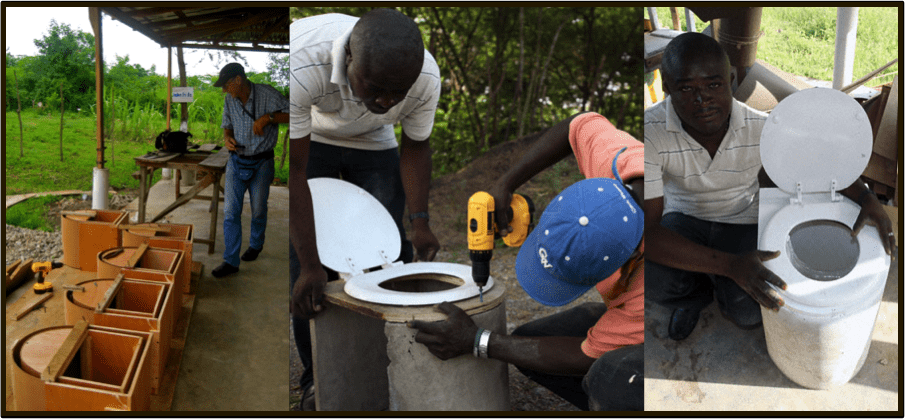
Advantages:
- Sturdy
- Inexpensive ($30 USD)
- Easy to clean up urine spills because there was no bottom
Drawbacks:
- Heavy
- Difficult to transport
- Small animals like rats can enter through the side opening
2014: The fancy wooden EkoLakay toilet
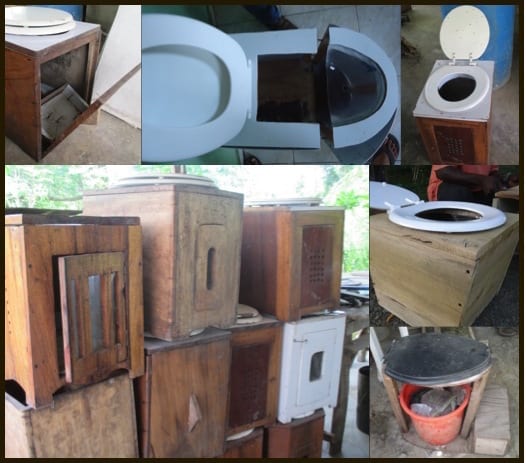
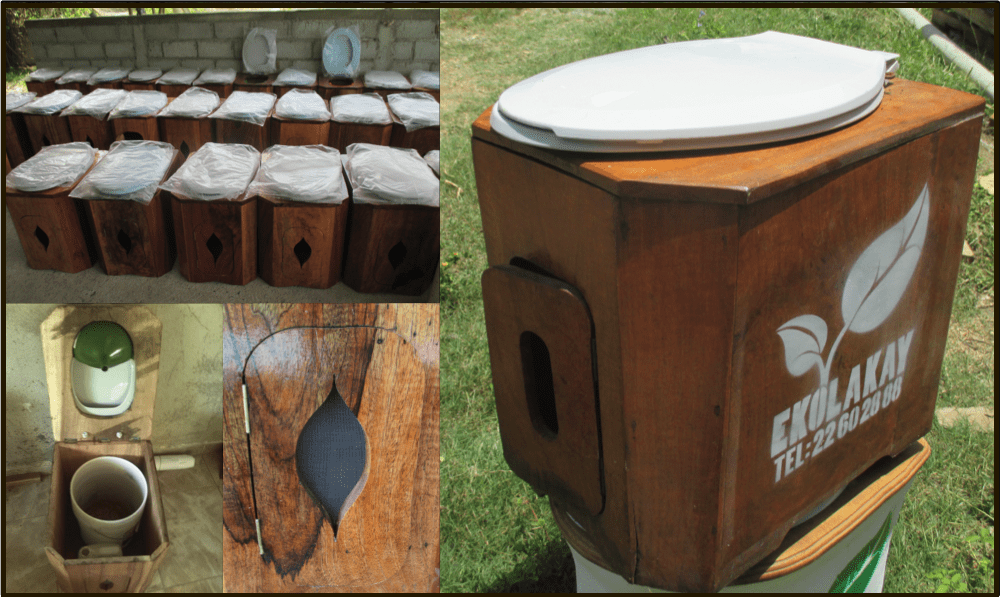
The most recent wooden EkoLakay toilet design is made by local carpenters out of plain Haitian wood. It has a wooden bottom lined with a plastic sheet to facilitate cleaning. It has a top loader for the pee gallon and poop bucket and a small front window to check the level of the pee gallon protected by a metallic screen. It’s topped off with a plastic seat.
Advantages:
- Beautiful
- Light and easy to transport
- Easy to check the pee gallon level
Drawbacks:
- Corrosion of the coupling of the top loader
- A bit hard to clean the bottom, especially if urine soaks into the wood
- Not suitable to humid areas or flood zones
2014: The Beautiful Ferro-Cement Ekolakay Toilet
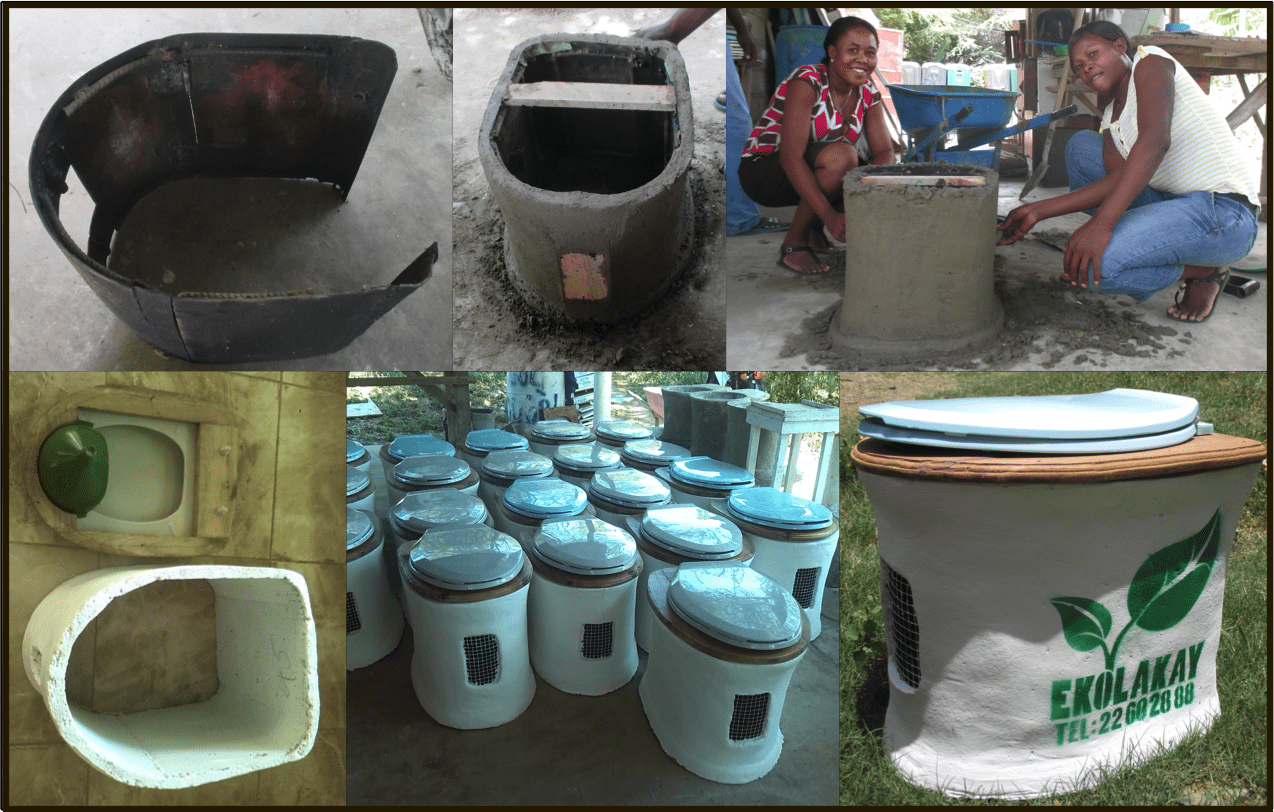
The ferro-cement EkoLakay toilet is our most cost-effective model yet. It’s a bottomless toilet made by local women contractors at our workshop out of cement reinforced with chicken wire and is lighter than the previous concrete toilet. It has a small opening in the front to check the level in the pee gallon. The opening has a chicken wire screen to prevent pests and flies from entering. The toilet is shaped by hand on a steel mold. The top is plain, but beautiful, Haitian wood and has a screwed-on plastic urinal (cut from a funnel) and a plastic toilet seat. The top is also removable.
Advantages:
- Inexpensive ($28 USD)
- Sturdy
- Suited to zones prone to flooding
- Bottomless, so easy to clean!
- Anyone can be trained to make them (does not require professional carpenters)
Drawbacks:
- Can break during transport
- It’s hard to check the level of the pee gallon with the front window
- Still a bit heavy
- The chicken wire of the opening corrodes quickly
Some Serious R&D on Urinal Design
Urine diversion systems are not exactly the kind of product you can find easily or inexpensively in Haiti. Some companies produce them abroad, like the one we were using in our Artsy Wooden Box, for example, where the urinal is directly integrated into the seat. The one we used in the Artsy toilet was made locally out of fiberglass and the urinal was super durable and easy-to-use. The only drawback was the cost: $75! The seat plus urinal itself was expensive compared to our current costs to produce an entire new EkoLakay toilet, which is now between $35 and $50. Thus we continue to do serious R&D on a suitable alternative for producing, instead of purchasing, our very own UD systems. Following the Stanford pilot (see Shiny Formica re.source Toilet above), we tried to make our own homemade vacu-formed urinals using the same process as that of the re.source researchers: out of a plastic sheet using a kiln mold, an electric heater, and a vacuum. The urinals were made by molding a plastic sheet to a concrete or clay mold and then applying heat and pressure using an electric heater and a vacuum engine (see photo below). Sadly, the quality of the urinals produced varied a lot and they tended to break easily, especially the tip of the urinal. Additionally we could not find the plastic sheets that we needed in Haiti. Because of these challenges we discontinued production. 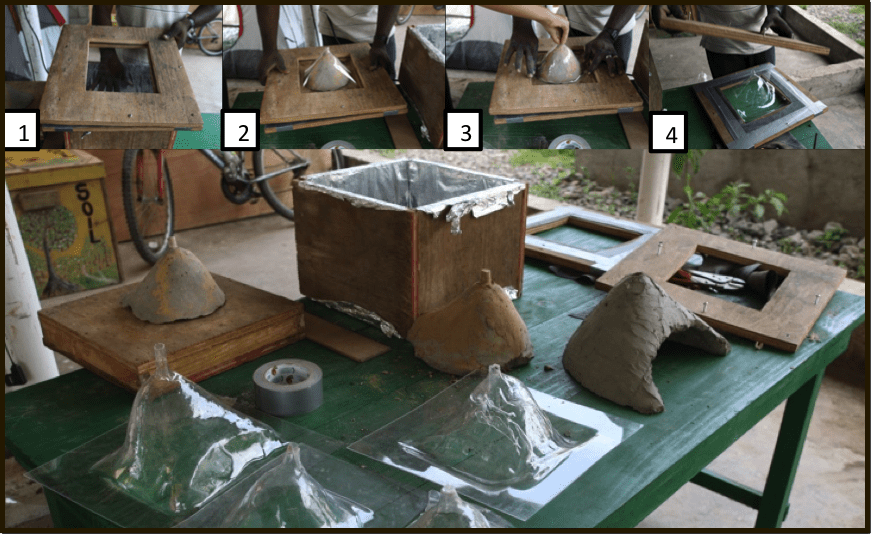 We then partnered with a local professional school to make welded galvanized iron urinals. These were installed in approximately 200 toilets, sometimes replacing the broken plastic molded urinals. Sadly, after a while, we realized that the supposedly galvanized iron we were using was not truly galvanized. Because of the corrosive power of pee, these urinals started to be corroded at the welded junctions. Thus we had to find new innovative solutions. We found some plastic funnels, made in the Dominican Republic, that could be cut into nice urinals. The challenge with the funnel urinals is that, although they are easy to clean and durable, they do not fit perfectly in the toilet. Additionally as they are only made in the Dominican Republic, they can be hard to access in large quantities in Haiti. They cost about $3 USD per funnel.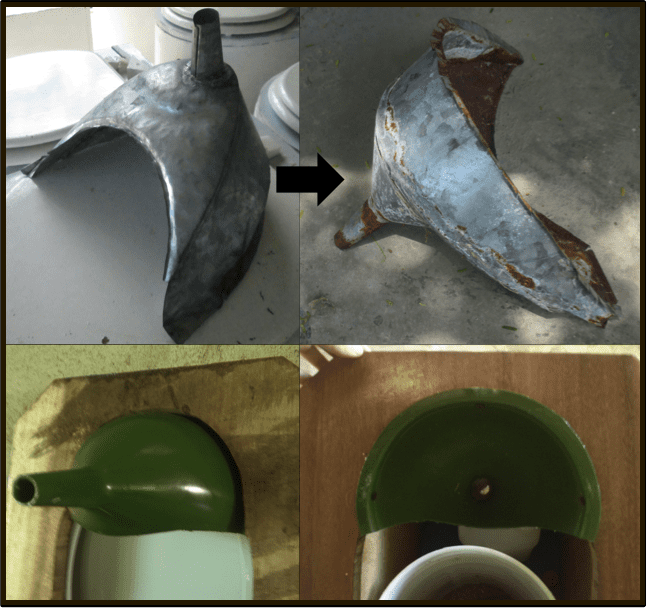
We are currently working in collaboration with re.source, frog design and Sanivation to design a plastic mold for urine diversion toilet seat which could be made in China and then imported to Haiti and Kenya for use by local plastic manufacturers. This would allow us to have a standardized plastic product that could be made locally and inexpensively. We'll post about the outcomes of this collaboration over the coming posts, so keep your eye on the SOIL blog! Back to Top
Some of our Extraordinary Trials
Designing a new household toilet was not always as smooth of a process as our pretty timeline here might indicate. We have faced many challenges throughout the iterative design process, and our team came up with many innovative ways to address these challenges. Some of these innovations are still being used today, but many - include sliding front loaders for buckets and pee gallons, pivoting pee gallon loaders, external urinals, and more! - are now thankfully just distant memories!