New SOIL Board Member!
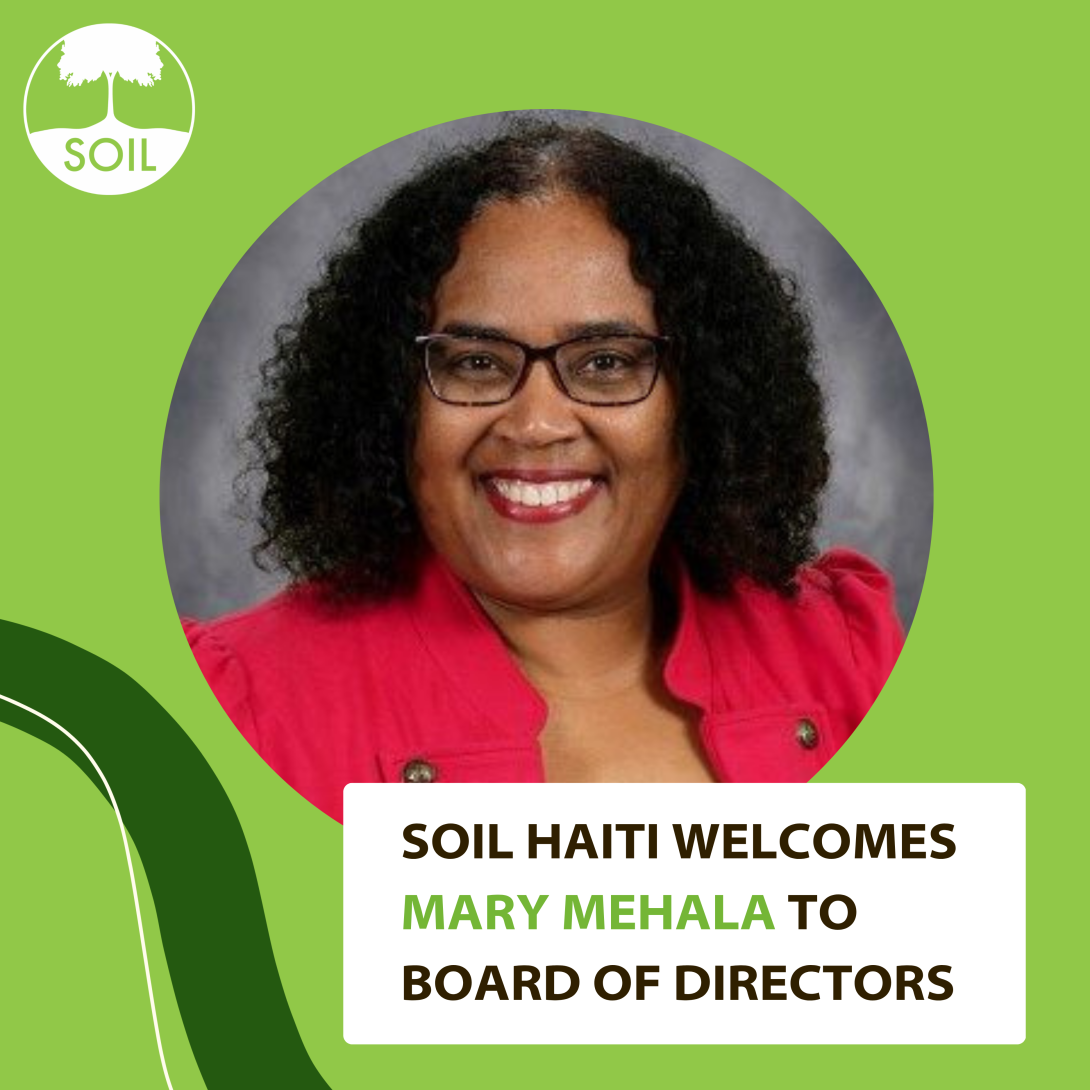
SOIL welcomes Mary Mehala to our Board of Directors!
SOIL is lucky to have a Board full of compassionate, thoughtful practitioners who bring expertise, lived experience, and a shared commitment to Haiti’s future. It’s our pleasure to welcome each new Board member with an interview that lets our readers know a little more about who they are and their connection to SOIL’s mission. In this blog, you’ll get to know Mary Mehala, one of SOIL’s newest board members, and what giving back to Haiti means to her.
We know you connected with SOIL through the wonderful Erica Lloyd at Seeker’s Church. Was that your first introduction to SOIL, or did you know about our work before then?
I actually found Seeker’s Church rather serendipitously, on a sign at a stoplight. Looking back, I think that Erica did ask me if I was interested in being on the SOIL finance committee, but I didn’t have the bandwidth with how busy I was with work and family at the time.
Once I had more flexibility in my life, I knew I wanted to give back to Haiti in some way and joining SOIL’s Board felt like a natural extension of my identity and values. My mom is Haitian – she came to the US in the 1960s and my father is from Martinique. Growing up, our house was filled with the sounds of both Kreyols being spoken. My sisters have all been to Haiti, but I haven’t yet. This opportunity with SOIL was another way for me to get connected.
What is the impact that you see SOIL is having and why does that feel important to you?
Having French and American nationality, and Haitian and Martinique ethnicity, I often ask myself: what can I do, leveraging all of these perspectives, to make Haiti a better country, rather than only be critical of the short falls that we are seeing?
Both the United States and France are largely accountable for the present-day situation in Haiti. If you want to understand why Haiti is facing extreme poverty and instability, you need to go back to historical events like the freedom ransom and other extractions of wealth from the country through military force. We are often in such a rush to land on simple conclusions about the world. It is better practice asking the question: historically, what happened here? And how can we use that context to appropriately address the pain we have been dealt?
When we talk about sanitation, we talk about the foundation for everything. In fact, when the United States developed our sanitation system, it revolutionized the economy. That’s why SOIL’s work matters so much to me. SOIL is not in the business of charity for the sake of giving away free things; we are investing in the foundation of the country’s sovereignty and success.
I heard that since you joined SOIL’s Finance Committee, we had our best call in a decade and discussed some exciting ideas around SOIL’s investment policy. Could you share more about that conversation and your thoughts on how nonprofits can build financial resilience?
I'm not an investment banker, but I learned a tremendous amount from the investment professionals I worked with on school investment committees and was happy to share what I learned. Those who look after the school’s finances care about the students and think deeply about the long-term sustainability of each institution where I worked. It’s not about maximizing aggressive growth; it's about slow and steady investment strategies that set up future generations for success.
When funders and implementers are truly aligned on an organization's mission, financial success follows naturally. The best partnerships go beyond transactions — they're built on a genuine love for the students, and the community as a whole.
Looking ahead, where do you hope to see Haiti in the next ten years? What gives you hope when you think about organizations like SOIL tackling some of the world’s toughest challenges?
SOIL's work has given me a lot of hope. Proper sanitation reduces illness and creates jobs — when you are chronically sick with no resources, every part of life becomes harder. Something as fundamental as access to a clean, safe bathroom matters deeply to a person's dignity and wellbeing.
In the next ten years, I believe SOIL is going to grow significantly. We haven't come close to hitting the pinnacle of what's possible in Haiti. Investors and funders want to see that the foundational work is taking hold — and with organizations like SOIL, we can see that it is. My hope is that a decade from now, people, institutions, and organizers will have come together alongside with Haiti to ensure that their most basic needs are met.
Do you have any fun facts about yourself that you’d like SOIL supporters to know?
I used to be an aerobics instructor in the 80s – and it’s just like you might picture it: we were jumping around in brightly colored leotards and having a blast! I was also a majorete in high school.
What else? Oh, I have twin girls. I lived in Paris and in the South of France, near Marseilles, and I came to love hiking after living in that region. I grew up in Queens, which is a beautifully diverse place. It offers a unique international experience as one is able to hear different languages, and try foods from all over the globe, without leaving the USA.
I currently live in Western Pennsylvania, and while diversity is sparse — and the commentary on Haitians and immigrants during this past presidential election cycle disheartening, I find ways to share my culture and share in the culture of others.
All of those places and experiences have shaped who I am today. Bringing that history, that joy, and my pride into my work with SOIL’s Board feels like a beautiful next chapter and I am excited to see what lies ahead.