What are People Willing to Pay for EkoLakay?
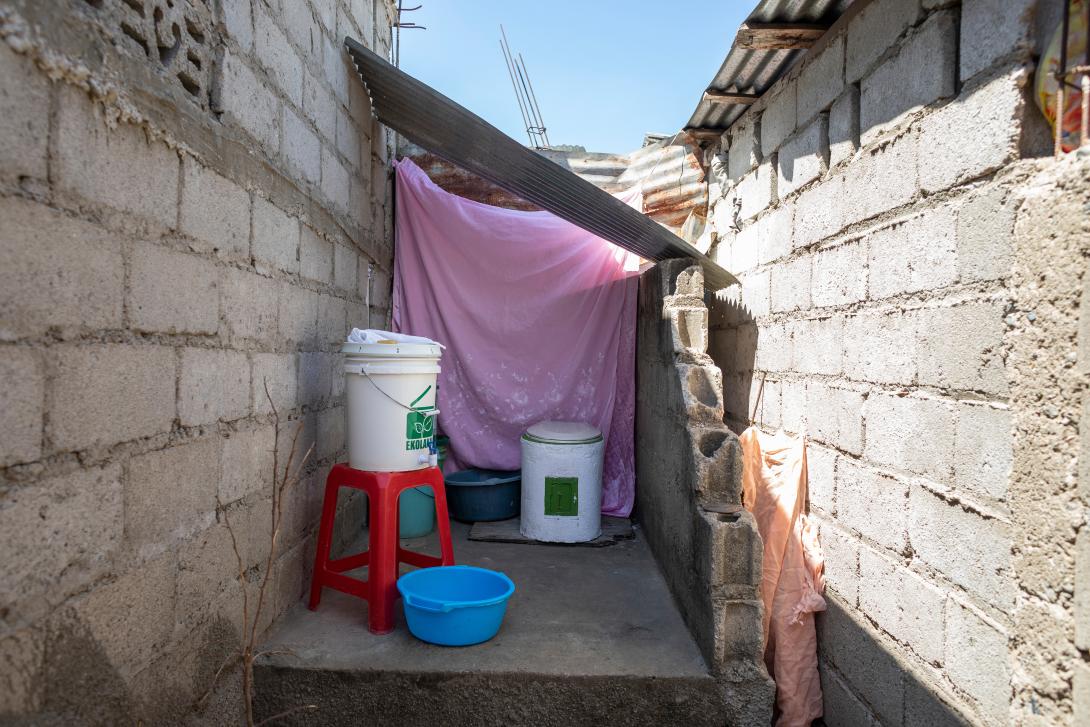
A household EkoLakay toilet in one of SOIL's sixteen service areas across Northern Haiti.
We’re striving to make sure everyone has access to the sanitation services they need, at a price point they can afford.
But in a country where a devastating colonial debt has left the majority of the population living below the global poverty line (income of $3.65 per day), creating a budget line for sanitation is difficult. Traditional sanitation options such as flush toilets, septic tanks, or even pit latrines can be prohibitively expensive, and many households are left without a toilet at all.
At SOIL, we’re in business to change that. Our EkoLakay container-based sanitation service, with weekly waste collection and treatment, is designed to service economically vulnerable urban and peri-urban neighborhoods, and is recognized by the World Bank as one of the only household-level safely managed sanitation options in all of northern Haiti. According to the Inter-American Development Bank’s 2021 assessment of the city’s sanitation services (Shit Flow Diagram), SOIL runs the only safely managed service in Cap-Haïtien while creating 85 full-time and 72 part-time jobs—turning an essential public service into a source of livelihoods that improve the local economy.
However, even at a low monthly subscription fee of 350 HTG (less than $3 USD), some households still face a barrier to pay—signaling to our team that targeted service discounts could expand EkoLakay coverage to the city’s most under-resourced households. At the same time, our subscription fee only covers ~10–15% of our operating costs, leaving SOIL caught between two competing pressures: our funding partners encouraging greater cost recovery, and the economic realities facing our clients necessitating a lower, more affordable monthly fee.
Thus the question presents itself; what price would enable everyone to afford an EkoLakay toilet at home?
To find out, we surveyed 603 households across four neighborhoods (Cap-Haitien, Foujwol, Karakol, and Limonad) about their willingness to pay (WTP) for EkoLakay, then held focus groups with community members to better understand the results. A multivariate regression helped us understand the underlying factors that are associated with WTP: household wealth, privacy in a household’s current sanitation setup, and satisfaction with their existing toilet.
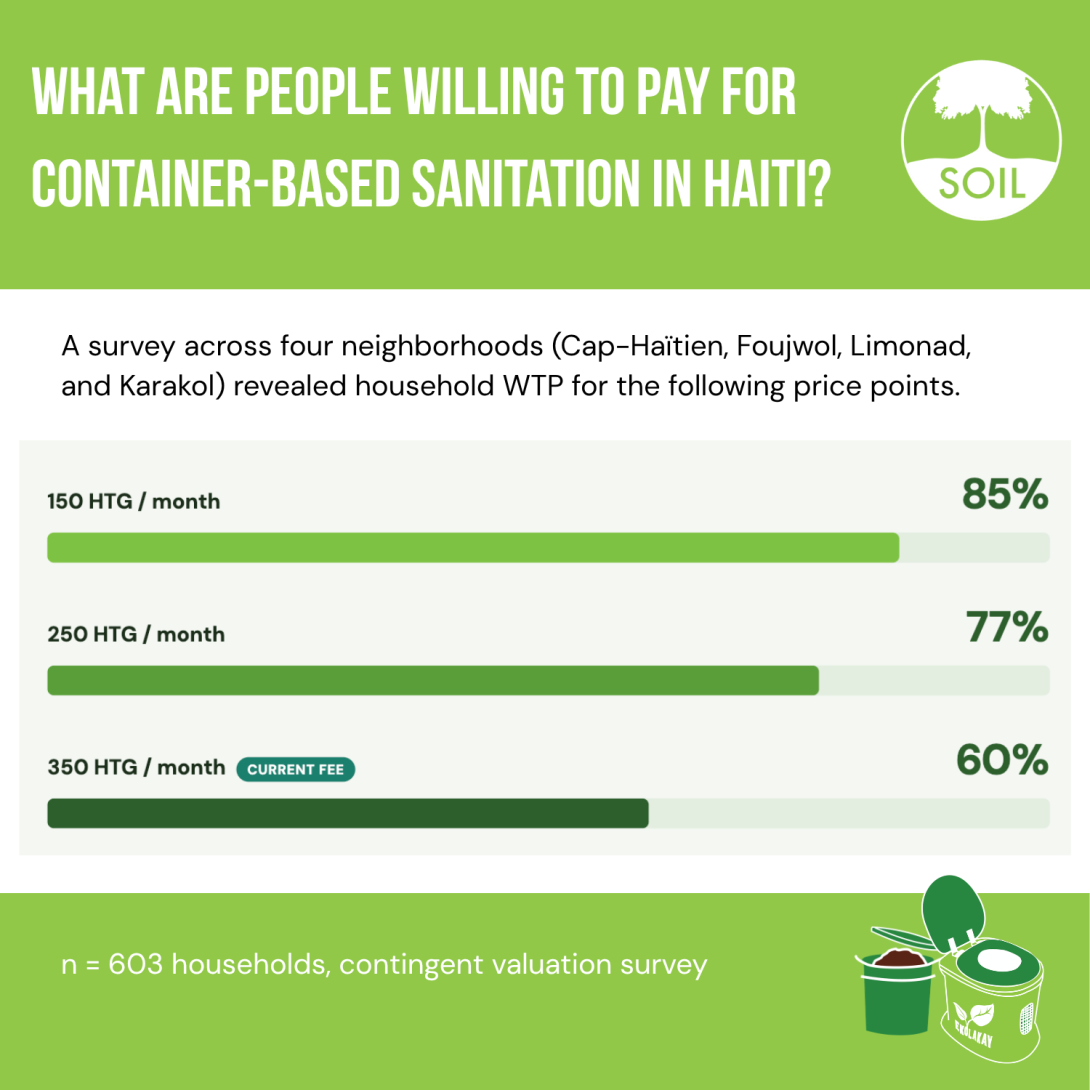
Our research findings from this study suggest that bringing the monthly price down to 150–200 HTG through targeted discounts could put EkoLakay within reach for 75–85% of households in our study area. It’s a finding that could help SOIL—and government partners—think strategically about what people can afford to pay for essential services, and how pricing shapes access.
We found that the starting price a household was presented with during the survey (between 100HTG to 700HTG) influenced what they subsequently said they were willing to pay—a well-documented phenomenon in contingent valuation research.
And in low-resource settings like Haiti, what people say they are willing to pay can overstate what they are actually able to pay when a monthly bill arrives. Therefore, we view these stated WTP figures as a starting compass.
In community focus groups, participants consistently ranked EkoLakay above pit latrines. Even households that already had a private toilet described reasons for why they would choose to pay for an EkoLakay toilet, including lower long-term costs, a better user experience, pest control, and resilience to flooding.
For households with a flush water closet (WC), often considered the gold standard, the appeal was different: convenience and capacity. In crowded homes, particularly those where portions of the house are rented to different families, one toilet may simply not be enough.
As one community leader explained:
“If I were to rank the sanitation solutions available, I would put hygienic toilets (WCs) first because they don’t pose a big problem; second, I would put EkoLakay toilets; and third, I would put latrines… Someone who used to defecate in the open or who has a latrine, choosing the EkoLakay toilet is the best option that is closest to a definitive solution. This means it wouldn’t be surprising for someone who has a domestic toilet [latrine] to switch to EkoLakay. However, for someone who had a hygienic toilet and then switches to EkoLakay, one of the reasons could be that the household has many people and only one toilet for everyone. Or if they rent part of the house, they might take EkoLakay for themselves or for their tenants.” — Community leader
Another group of community leaders described how this plays out in Limonad:
“It depends on the number of people living in the house. For Limonad, in most houses, even if the owner lives there, they rent out a part of it. Renters often do not want to use the same toilet as others. Even if everyone in the house is a renter, they often want a toilet for each level, because in some houses, they rent by level, so there may be one toilet for the ground floor and one for the upper floor.” — Community leaders
For other households, the appeal was simply economic. One community member from Limonad explained:
“For me, I think it [EkoLakay service] is less money! Because when the person’s toilet is full, it costs a lot to empty it. Whereas for EkoLakay, there’s no question of a full toilet.” — Community member, Limonad
A community leader made the same comparison:
“There is someone I encouraged to use the service because his toilet is starting to fill up. And the money he will pay EkoLakay for a year won’t even be a third of what they would pay to clean [empty] his private toilet. So, it’s better for them to join EkoLakay. This means there are people who opt for the EkoLakay toilet because their own toilet is full.” — Community leader
And sometimes, the difference came down to the experience of using the toilet itself:
“In addition, the EkoLakay toilet is better designed than domestic toilets [latrines]. Because when you sit on it, it feels like you are sitting on a hygienic toilet, the way the toilet seat is designed.” — Community leaders
These conversations helped put the WTP data into context. People were not simply assigning a monetary value to a toilet. They were weighing the cost of EkoLakay against the inconvenience, privacy, dignity, and risks associated with the alternative sanitation options available to them.
As our team predicted, wealthier households reported higher WTP. They have more room in their budgets for basic services—a pattern echoed in research on willingness to pay for sanitation and in a scoping review of emptying services.
More surprising was the relationship between satisfaction and WTP. Households that were already satisfied with their current toilet were willing to pay more for EkoLakay, rather than less. One possible explanation is that once people experience a clean, reliable, and dignified toilet, they place greater value on maintaining that standard of service.
Scale is not simply about reaching more households. It is also about asking which households our service is reaching.
Better data can help us to navigate what pricing structure households can afford, what our customers value, which households are facing the greatest barriers, and where discounted pricing can make the greatest difference.
Our mission is to work in partnership with the Haitian government to ensure the basic human right of safe, dignified, and sustainable sanitation in urban Haiti. We deliver on this mission through a circular sanitation economy model that provides safe, affordable sanitation, while transforming human waste into a productive environmental resource across the full value chain. Thank you to all of the researchers, scientists, clients, workers, families, and supporters who help us further this mission in Haiti.
Reader’s note: Throughout this blog, the terms “subsidy” and “discount” are used interchangeably. For the Haitian government, it is important to distinguish SOIL’s approach from the history of NGOs and foreign actors subsidizing products and services in Haiti in ways that can distort local markets. For the purposes of this research, we’ve used the term “subsidy” to describe the mechanism through which service discounts are provided and evaluated.