Reaching the Households Left Behind: New Data Confirms EkoLakay's Role in Haiti's Sanitation Gap
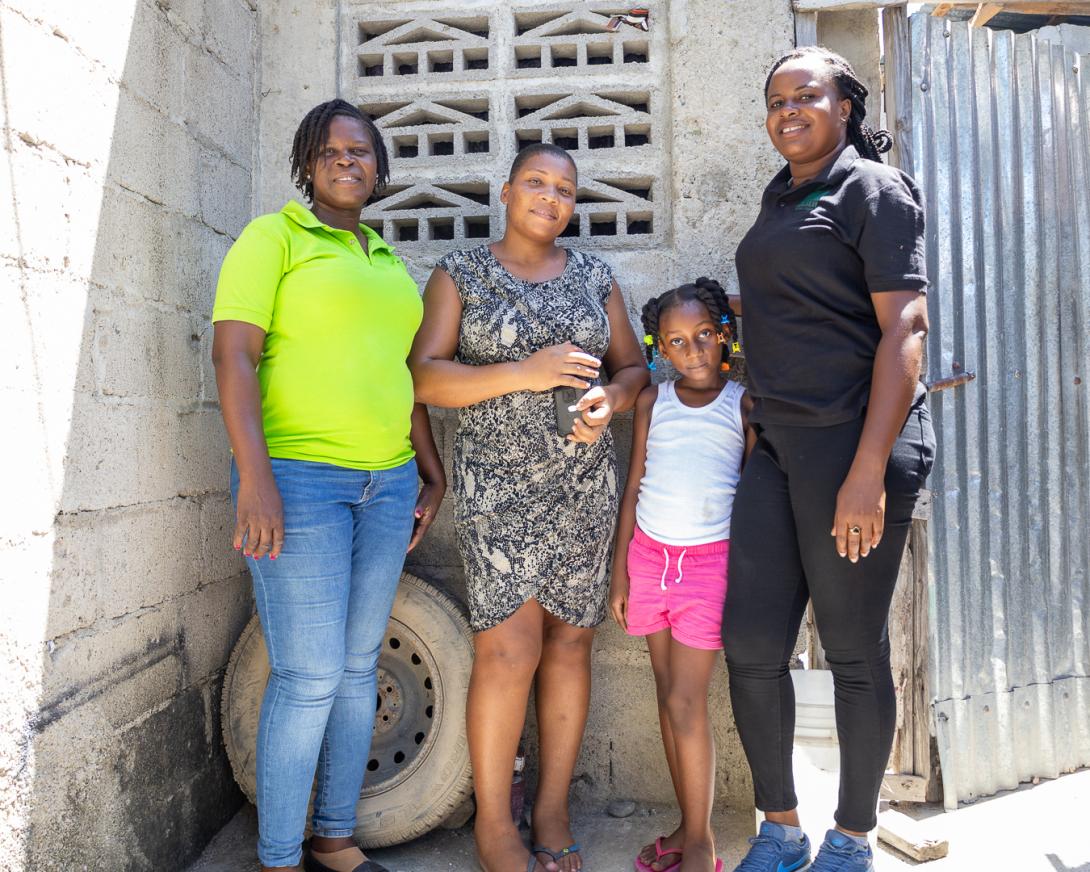
SOIL staff visit EkoLakay customer Anotin Moreau and her child in their neighborhood of Petitans, Cap-Haïtien.
In 2021, a study of EkoLakay households published in the Journal of Water, Sanitation and Hygiene for Development made a striking claim: before subscribing to EkoLakay, our customers were more likely to practice open defecation or rely on sanitation outside their own home, and less likely to have a private, improved toilet, than the average urban Haitian. In other words, EkoLakay isn't just adding another sanitation option to the market, it is reaching the households that other solutions missed. That finding relied on subscribers' memories of their circumstances before they joined EkoLakay. Five years later, we have a different kind of evidence for the same idea.
In 2023, SOIL completed a quasi-census survey of over 4,000 households across eight communities in and around Cap Haïtien, as a baseline for a results-based financing pilot with the Inter-American Development Bank Lab. That survey, published this year in PLOS Water, gave us something we didn't have before: an independent measure of how many households in these specific communities were practicing open defecation, regardless of whether they had ever heard of EkoLakay.
The baseline lets us ask a sharper version of the 2021 question. We can't trace individual households from the census into our own customer records because the two datasets aren't linked, and we have no way to confirm that a given customer who reports having once practiced open defecation is one of the specific households the census counted. What we can do is compare two independently measured numbers side by side, zone by zone: the share of households the census found practicing open defecation, and, separately, the number of our current customers in that same area who tell us, on their own, that they used to do the same.
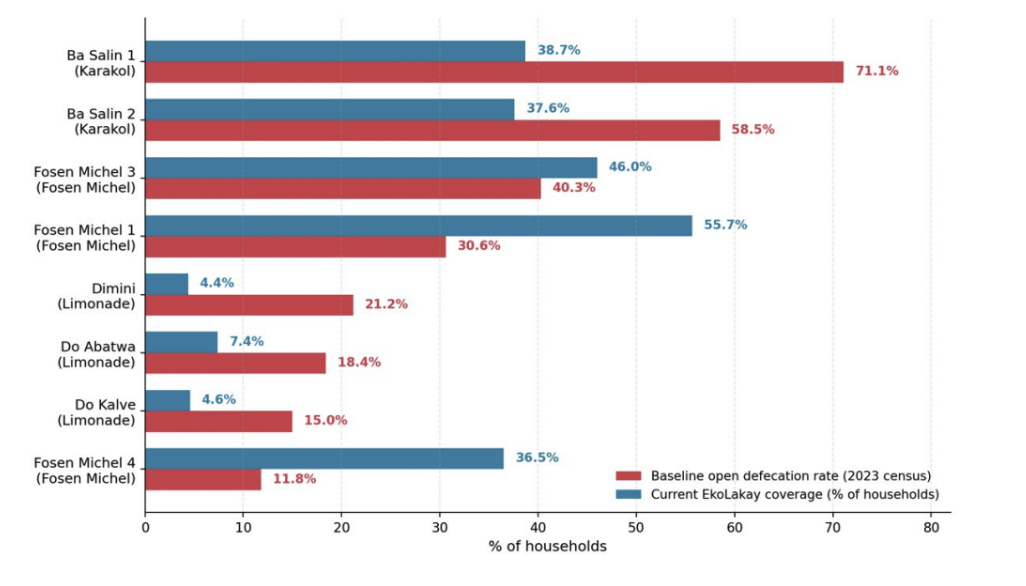
The two numbers vary enormously by community, which is itself revealing (Figure 1). Baseline prevalence of open defecation across these eight zones ranged from 11.8% in Fosen Michel 4 to 71.1% in Ba Salin 1, a reminder that "urban Haiti" is not one uniform context but a patchwork of neighborhoods with very different starting points. Our current coverage tracks that unevenness: EkoLakay reaches under 5% of households in Dimini but over half in Fosen Michel 1.
The most notable pattern is in Fosen Michel, where the number of current customers self-reporting past open defecation is equivalent to between a quarter and two-thirds of the size of that zone's entire baseline OD population (Figure 2). This tells us that the scale of former open-defecators within our current customer pool is large relative to the size of the problem the census documented in that zone — an indirect echo of the 2021 finding that EkoLakay disproportionately reaches this population.
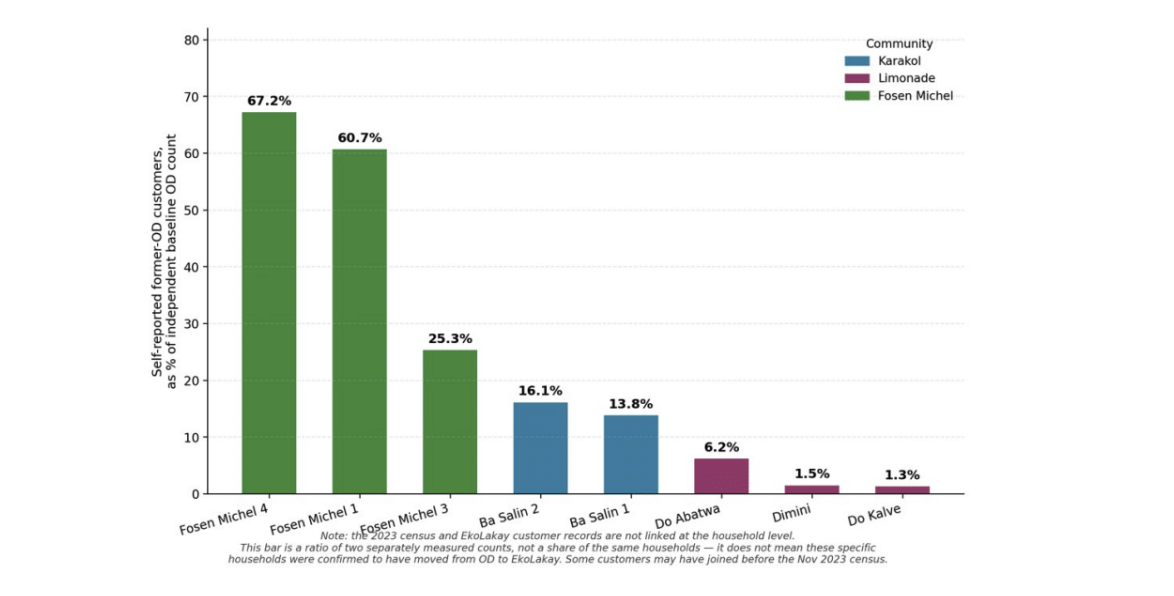
We want to be careful about what this comparison can and can't tell us. It's tempting to read these percentages as "we reduced open defecation by this much" in each zone, but at least three caveats matter. First, the census and our operational data were never linked at the household level, so we can't confirm overlap between the two counts, only compare their relative size. Second, some current customers may have joined EkoLakay before the 2023 census was even conducted, meaning the census would have already recorded them as having improved sanitation, not OD, which would inflate the apparent ratio. Third, many customers simply choose not to share their prior sanitation situation with us when they sign up, so our operational data likely undercounts how many former open-defecators we actually serve.
Even with those caveats, this second, independent dataset reinforces what the 2021 sanitation arc study first suggested: EkoLakay is disproportionately reaching households who were previously left out of Haiti's private, improved sanitation options. That's the population our model was built to serve, and it's the population that most needs affordable, dignified sanitation to reach them where they are.
To learn more about EkoLakay and SOIL's work expanding access to safe sanitation services in northern Haiti, follow us on Linkedin.