Haiti Sets a Global First with Government Contract for Container-Based Sanitation Services
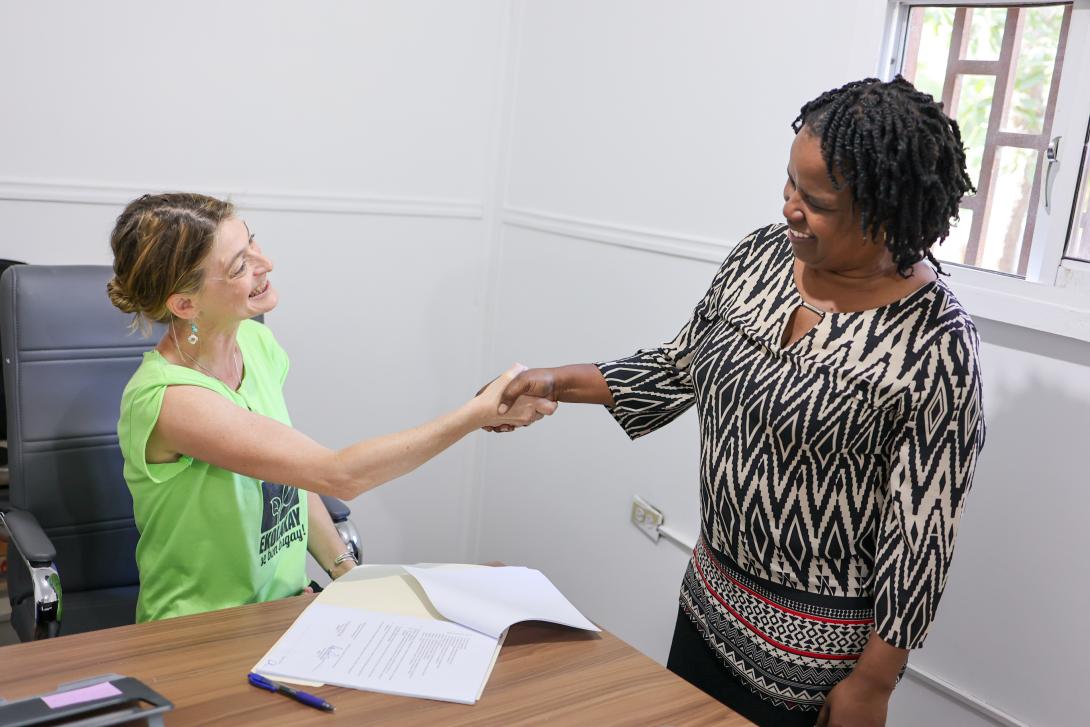
SOIL Executive Director Sasha Kramer and DINEPA Coordinator General Edwige Petit following the signing of the government Results-Based Financing contract, January 2026.
On January 20, 2026, Sustainable Organic Integrated Livelihoods (SOIL) and DINEPA, Haiti’s National Directorate for Drinking Water and Sanitation, finalized a landmark agreement that marked a major achievement for urban sanitation worldwide.
The agreement represents the first government-funded Results-Based Financing (RBF) contract for container-based, off-grid sanitation services delivered as an ongoing public service. The contract formalizes a public partnership between the Government of Haiti and SOIL, through which public funds are disbursed after independently verified sanitation outcomes are achieved through SOIL’s EkoLakay household sanitation service—currently serving more than 21,000 people each day in Cap-Haïtien.
This contract demonstrates how household sanitation and waste-treatment services can be financed in Haiti through public funds, provided by development bank support, to deliver measurable impact in one of the world’s most complex operating environments.
“This agreement represents a turning point for how sanitation services can be delivered and financed in Haiti,” said Edwige Petit, Coordinator General of DINEPA. “By paying for results, we are ensuring that public funds are directly tied to real, measurable improvements in people’s daily lives—while also respecting and strengthening the systems needed for long-term service sustainability.”
What the Contract Unlocks
Under the agreement, DINEPA commits public funds to pay for verified sanitation outcomes delivered by SOIL—covering the public service costs for approximately one-third of active EkoLakay clients, or roughly 1,400 households, during Phase II of the Paying for Sanitation Success initiative (2025–2027). Results payments are released quarterly, following independent verification (conducted by CLE) that households are receiving consistent, high-quality services.
This results-based approach aligns incentives across government, service providers, and funders by rewarding reliability, client retention, and operational efficiency. Unlike traditional development projects that are funded upfront and evaluated after completion, Results-Based Financing links payment directly to demonstrated performance and sustained service delivery.
Crucially, this contract differs from previous sanitation interventions by DINEPA in that it finances service provision, rather than infrastructure alone. Traditional loans and grants from development banks and bilateral donors have typically focused on infrastructure—such as toilets or treatment facilities. Yet in a country like Haiti, where sewer networks are absent, toilets remain disconnected from treatment sites unless ongoing service provision is also funded. The funding of services is essential for providing equitable access to sanitation in low infrastructure contexts. Without service funding there is a risk that resources put towards sanitation will only serve to deepen inequalities, a trend which the World Bank has seen throughout the sector.
Finally, the contract also lays the groundwork for the long-term integration of sanitation service provision into Haiti’s public budget. SOIL and DINEPA share a clear objective: to use this RBF mechanism as proof that rapidly deployable sanitation services—such as container-based sanitation—can deliver meaningful impact quickly—and form part of a broader menu of citywide sanitation services that merit sustained public financing.
Building a Model for Public Sanitation Services in Haiti
For SOIL, this contract reflects decades of sustained collaboration with Haitian public servants who remain deeply committed to expanding access to sanitation in Haiti. The significance and urgency of this effort is underscored by the country’s ongoing sanitation crisis: nearly 60 percent of the population still lacks access to improved sanitation, and repeated cholera outbreaks have laid bare the life-and-death consequences of systemic failures in sanitation systems and emergency response.
Since launching the EkoLakay service in Cap-Haïtien in 2013, SOIL has worked closely with DINEPA and its regional authority, OREPA Nord, to demonstrate that container-based sanitation can reliably serve dense urban neighborhoods—providing weekly waste collection, safe treatment, and environmental benefits at scale.
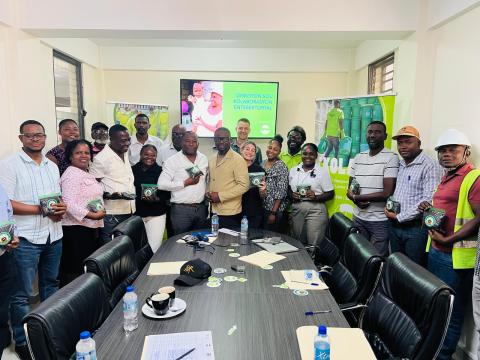
Agents from the Ministry of Public Health (MSPP) often accompany our sales agents at marketing events, going door-to-door to talk about the importance of safe sanitation within Haitian communities.
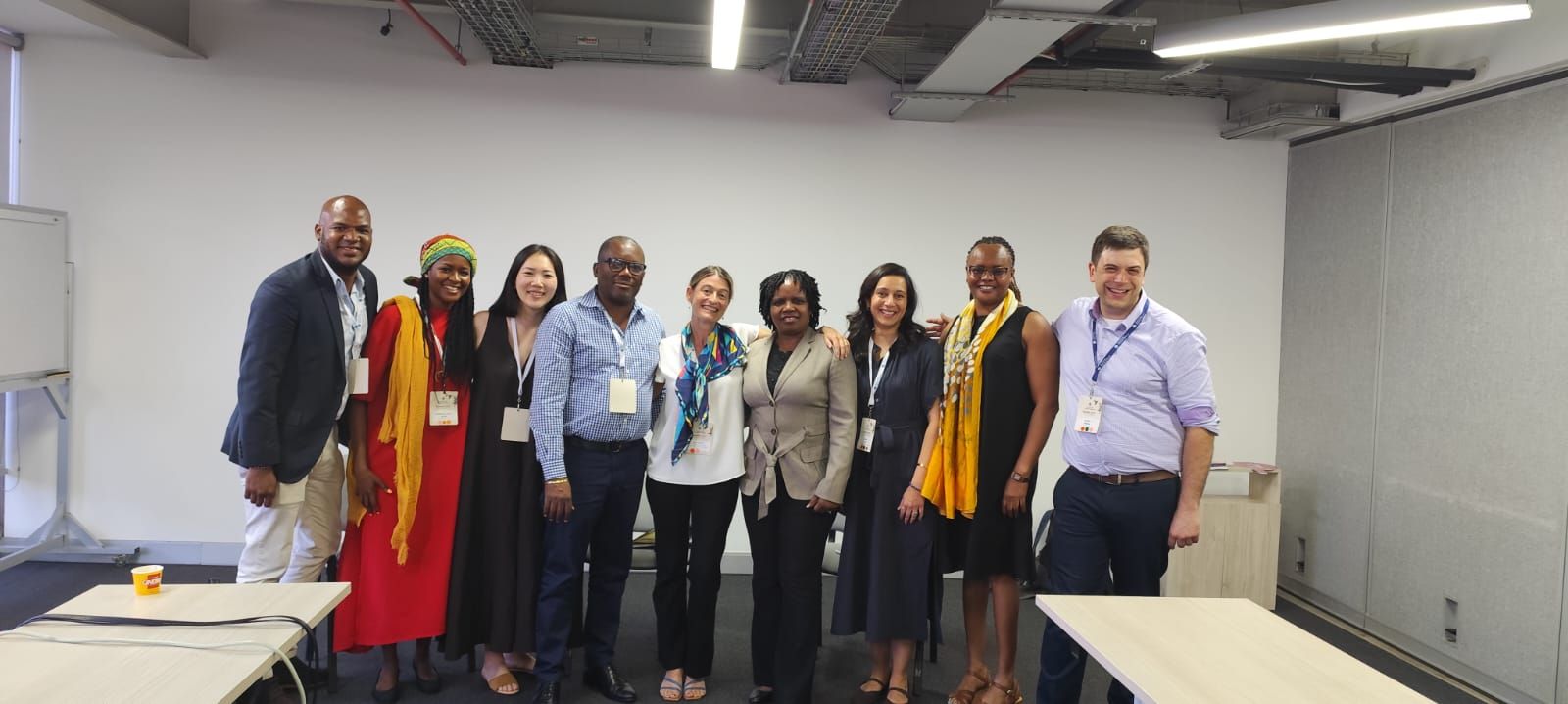
Haiti’s sanitation leaders, including Pierre Bernadin Poisson (Director of OREPA Nord) and Edwige Petit (DINEPA Coordinator General), have also carried this work onto the global stage—participating in international conferences such as World Water Week in Stockholm, the UNC Water and Health Conference, and the Outcomes Financing Alliance in Colombia, to advocate for the emergence of more solutions grounded in Haiti’s national sanitation agenda.
“This contract is deeply meaningful for our team, it represents a shared belief—built over many years—that sanitation is not a temporary intervention or a charitable add-on, but a core public service that people deserve and governments can support.” - Sasha Kramer
From NGO Service to Public Provision
For SOIL, this agreement marks a strategic shift—from operating an NGO-led service to helping build a replicable public–private partnership model for inclusive urban sanitation.
As the government partnership progresses, SOIL is focused on reducing per-household costs, strengthening earned revenue, and demonstrating affordability at scale—key steps toward future government contracts that can enable exponential growth of the service.
Together, SOIL, Haitian government officials, and a pioneering coalition of philanthropic funders are demonstrating that even in the absence of centralized sewer systems—while continuing to look toward a future in which such infrastructure exists in Haiti—governments can finance the ongoing provision of sanitation services that are rapidly deployable, dignified, environmentally regenerative, and accountable.
At a moment when global sanitation and development financing face significant constraints and retrenchment, the SOIL–DINEPA partnership offers a compelling counter-narrative: that local leadership, robust data systems, and effective public partnerships can unlock funding for essential services.
Rather than treating sanitation as a temporary project or external intervention, SOIL’s model reframes it as a public service—one that can be delivered incrementally, evaluated rigorously, and financed over time.
As implementation continues, SOIL and DINEPA aim to provide governments and funders with a replicable framework for financing inclusive sanitation services—one that broadens the set of tools available to address the world’s most pressing urban sanitation challenges.